Simplex or duplex fiber optic cable : what is the difference and which to choose ?
Contents
Fiber optic cables fall into two main families according to the number of strands : simplex (1 fiber) and duplex (2 fibers). This distinction is not about quality but about the communication mode between devices — and it can be a source of errors for those who do not understand the difference.
This guide explains simplex, duplex and BiDi in concrete terms, with real-world usage examples in residential FTTH and the datacenter.
Definitions: simplex and duplex
In communications, three transmission modes are distinguished :
- Simplex — unidirectional transmission (A transmits, B receives, never the reverse). Example : FM radio, broadcast television.
- Semi-duplex (half-duplex) — bidirectional but alternating. Example : walkie-talkie, you each speak in turn.
- Full duplex — bidirectional and simultaneous. Example : a classic telephone, both parties speak at the same time.
For fiber cable, we speak of simplex (1 strand) or duplex (2 strands in parallel). Note : a simplex cable can ABSOLUTELY do full duplex, via BiDi technology (two wavelengths on the same fiber, one in each direction).
Simplex ≠ unidirectional. A simplex cable can support full duplex provided you use BiDi transmitters that multiplex two wavelengths on the same fiber.
Simplex cable (1 strand)
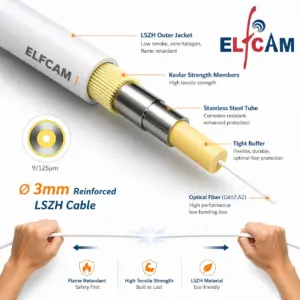
A simplex cable contains a single optical fiber in a single jacket. Typical use :
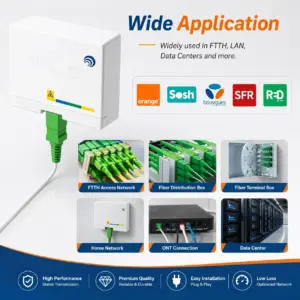
- Residential FTTH — the box receives and transmits on the same fiber via GPON/XGS-PON (different wavelengths)
- Long-distance BiDi links — 50% fiber savings
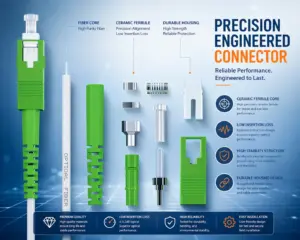
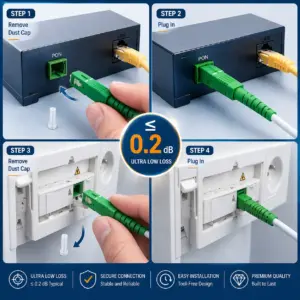
- PTO → ONT connection — a single SC/APC connector is enough
- Video broadcast distribution (true unidirectional simplex)
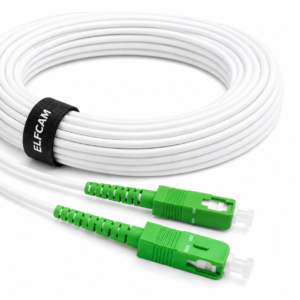
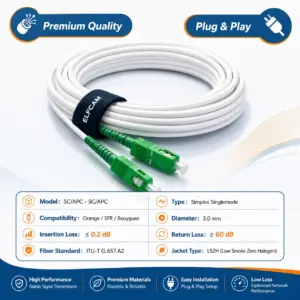
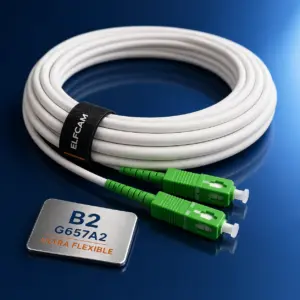
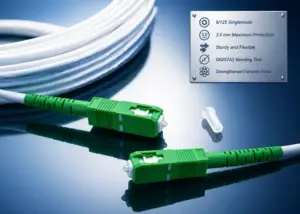
Elfcam simplex patch cords
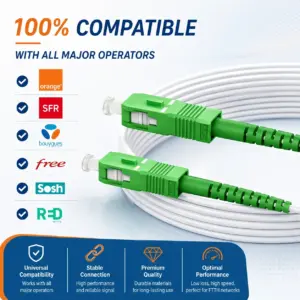
- Ref 319 — SC/APC single-mode OS2 armored, compatible with FR operators (Orange, SFR, Free, Bouygues)
- Ref 27261 — SC/APC G.657.B3 50 m "Pull-Eye" cable with pulling eyelet, for wall routing
Duplex cable (2 strands)
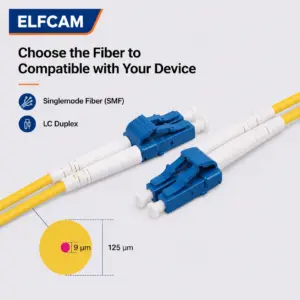
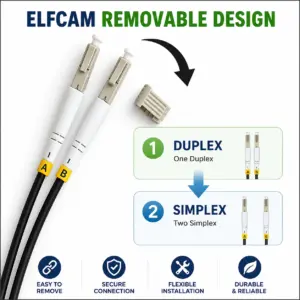
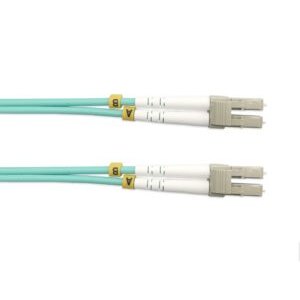
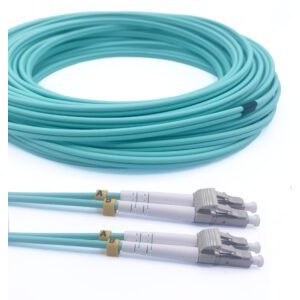
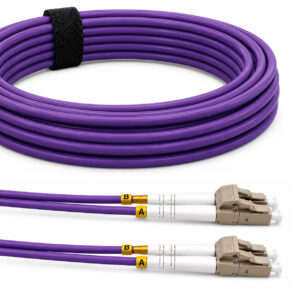
A duplex cable contains two fibers — one for transmission (Tx), one for reception (Rx) — often joined in a "zip" format (two bonded jackets) or grouped in a common jacket (Uniboot type).
Use :
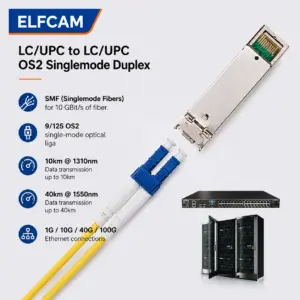
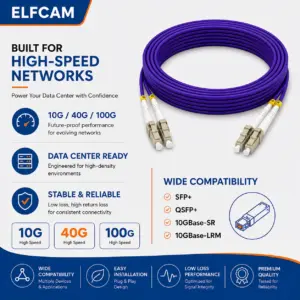
- Datacenter — nearly all SFP+/SFP28/QSFP+ modules use two fibers
- Fiber Ethernet switch — standard SFP ports (non-BiDi)
- Enterprise backbone — reliability and simplicity
- Measurement and instruments — test equipment
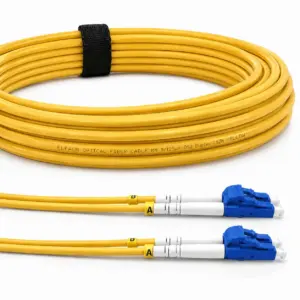
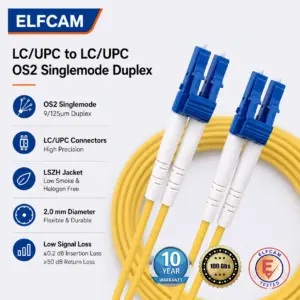
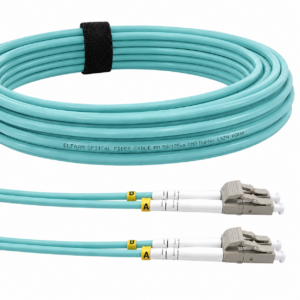
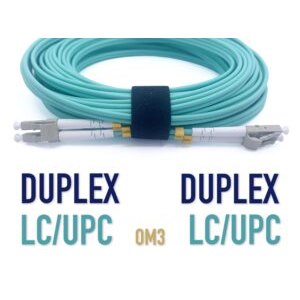
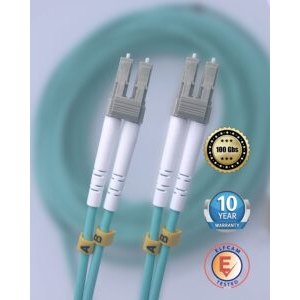
Elfcam duplex patch cords
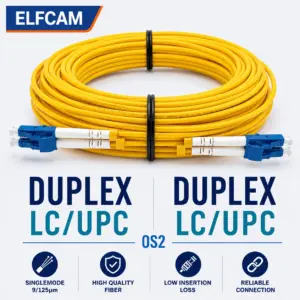
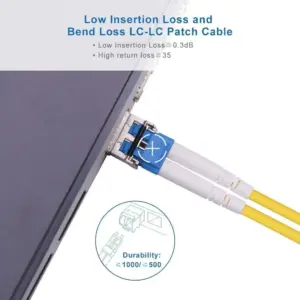
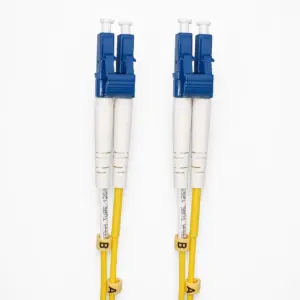
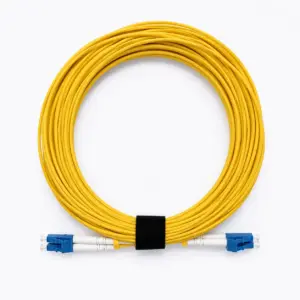
- Ref 425 — LC/UPC ↔ LC/UPC OS2 duplex single-mode
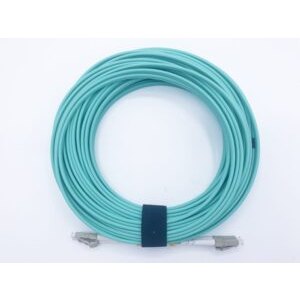
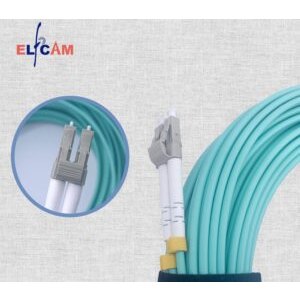
- Ref 400 — LC/UPC OM3 multimode duplex (aqua)
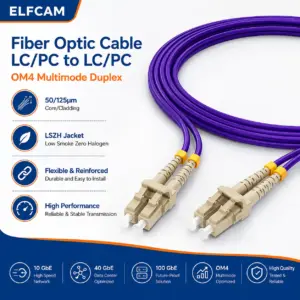
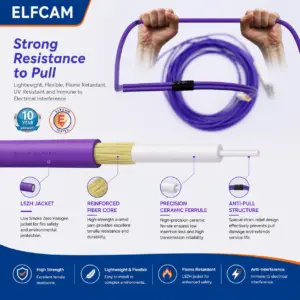
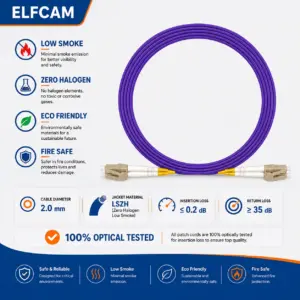
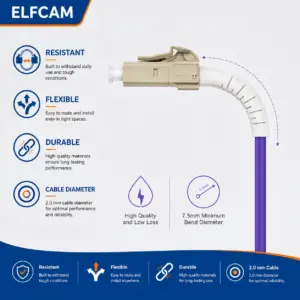
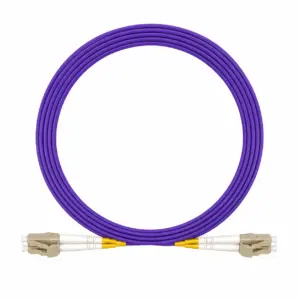
- Ref 1410 — LC/UPC OM4 multimode duplex (aqua/violet)
- Ref 405 — SC/APC ↔ LC/UPC OS2 duplex (hybrid)

Simplex vs duplex comparison
| Criterion | Simplex | Duplex |
|---|---|---|
| Number of fibers | 1 | 2 |
| Cable price (equivalent length) | ~50% of duplex | Reference |
| Transmitters required | BiDi (WDM 2 wavelengths) | Standard (1 wavelength) |
| Transmitter/receiver cost | More expensive (BiDi modules) | Cheaper (standard SFP) |
| Bulk | Minimal (1 thin cable) | Moderate (Y or zip cable) |
| Installation | 1 connector | 2 connectors (mind polarity) |
| Polarity error risk | None | High (swapping Tx/Rx) |
| Dominant use | FTTH, operators | Datacenter, enterprise |
When to choose simplex or duplex ?
Choose simplex if…
- You are installing residential FTTH (GPON/XGS-PON requirement = single-fiber)
- You are deploying over long distances (10-80 km) and want to save on cable
- Your equipment is BiDi-compatible (1G or 10G BiDi SFP modules)
- Space in the cable trays is limited
Choose duplex if…
- You are in a datacenter with switches and standard SFP modules
- You want the simplest solution (cheaper transmitters, less configuration)
- You anticipate frequent equipment changes (duplex = universal standard)
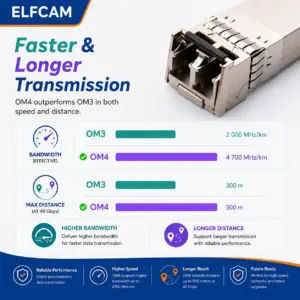
- You are deploying short links (< 550 m on multimode OM3/OM4)
BiDi technology: duplex on 1 strand
BiDi (Bidirectional) technology uses a simplex cable with two different wavelengths :
- 1310 nm in one direction (Tx on transmitter A → Rx on receiver B)
- 1490/1550 nm in the other direction (Tx on transmitter B → Rx on receiver A)
This technique is at the heart of GPON (operator FTTH network) and of cost-effective datacenter SFP BiDi modules. It halves the amount of fiber required, which is critical for long-distance deployments.
Practical rule
For residential FTTH : always simplex SC/APC, the standard imposed by French operators.
For enterprise datacenter : duplex LC/UPC OM4 except in specific cases (tight fiber budget, long distance → BiDi).
FAQ — Simplex vs duplex
1Can a duplex cable be used as simplex ?
2What is the difference between Uniboot and zip duplex ?
Uniboot : two fibers in a single more compact common jacket, with a movable LC duplex connector (push-pull). Modern high-density datacenter format, saves 50% of space in the racks.
3Is residential FTTH simplex or duplex ?
4Are my SFP+ 10G modules simplex or duplex ?
5Tx/Rx polarity reversal : what happens ?
6Is a simplex or duplex cable more fragile ?
7Can a simplex cable be spliced with a duplex one ?
8Where to buy simplex and duplex fiber cables ?
In summary
Simplex = 1 fiber, the choice for FTTH and long-distance BiDi. Duplex = 2 fibers, the choice for datacenter and standard SFP equipment. The decision is made according to the transmitter type (BiDi or standard), the distance and the environment.
Browse our simplex, duplex ranges and our SFP/SFP+ BiDi modules to configure your fiber link.