Bend-resistant fibers and small-diameter fibers : the G.657 guide
Contents
Standard single-mode G.652 fiber has been used for 40 years across all telecoms. But since 2006, the ITU-T has defined a derived standard — G.657 — which lets fibers withstand very tight bends (radius 5-15 mm) without losing signal. This advance made the massive rollout of residential FTTH possible, where fibers must pass through right angles, mouldings and cramped cabinets.
This guide explains the G.657.A and G.657.B standards, their optical mechanism and when to favor a small-diameter fiber (80/170 µm instead of the standard 125/250 µm).
Why bend-resistant fiber ?
When an optical fiber is bent too tightly, the light signal escapes from the core through the cladding — this is bend loss. On a standard G.652 fiber, a 15 mm radius already introduces 0.5-1 dB of loss ; at 5 mm it is catastrophic (>10 dB).
Yet in a residential FTTH installation, the fiber must :
- Pass through cramped cabinets (PBO 200×200×60 mm)
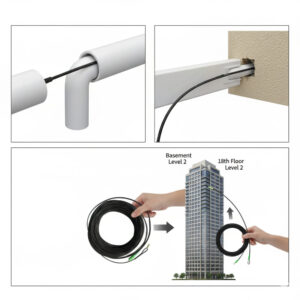
- Fit into decorative mouldings with right angles
- Run through ducts and technical conduits with bends
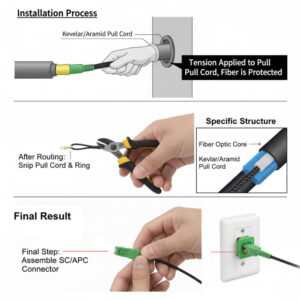
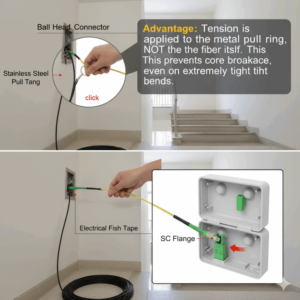
- Be bent behind the wall PTO to reach the box
The difference in practice : a standard G.652 fiber forces you to maintain a minimum radius of 30 mm everywhere. A G.657.B3 fiber accepts 5 mm without degradation — a 6× compactness factor.
The G.657 standard: classes A and B
The ITU-T G.657 recommendation defines two main classes of bend-insensitive fibers :
| Class | Minimum radius | G.652 compatibility | Typical use |
|---|---|---|---|
| G.657.A1 | 10 mm | Full | Standard FTTH access |
| G.657.A2 | 7.5 mm | Full | FTTH, internal connection |
| G.657.B2 | 7.5 mm | Limited | Tight installations |
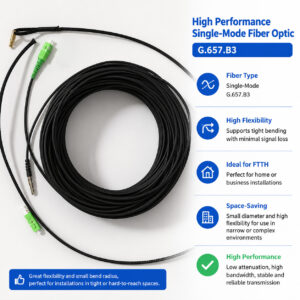
| G.657.B3 | 5 mm | Limited | FTTH patch cords, PTO, mouldings |
Class A (Access) — 100% compatible with standard G.652, usable anywhere G.652 works. Bend loss < 0.25 dB over 10-15 turns around a 7.5-10 mm mandrel.
Class B (Building) — designed for constrained environments (buildings, cabinets). Optical parameters slightly different from G.652, which can limit interoperability on very long mixed links. Near-zero bend loss even at a 5 mm radius.
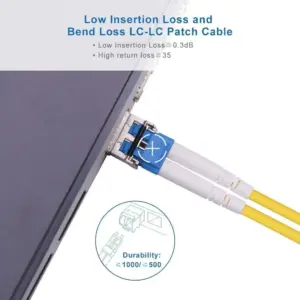
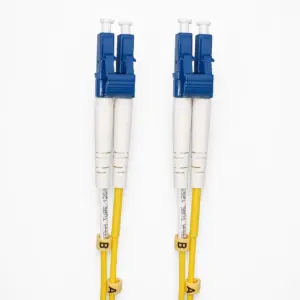
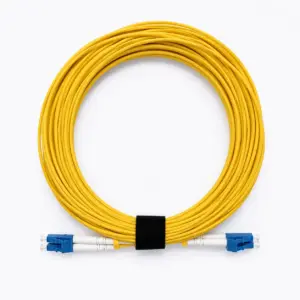
Recommended Elfcam G.657.B3 cables
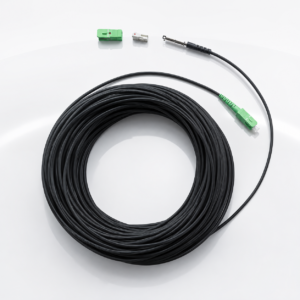
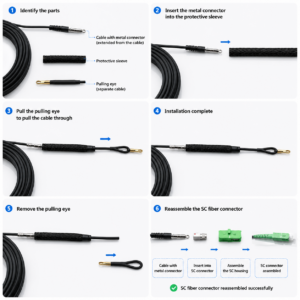
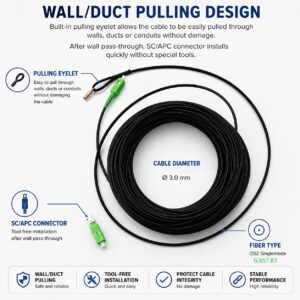
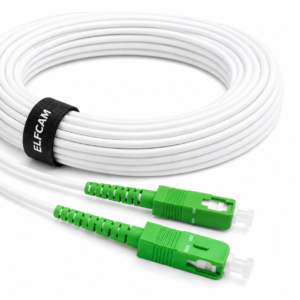
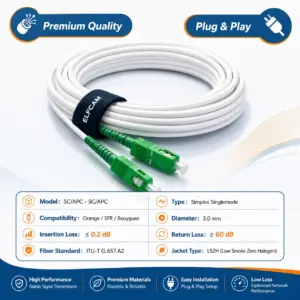
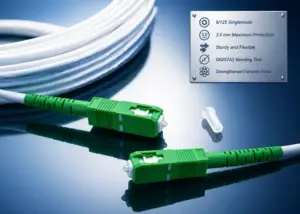
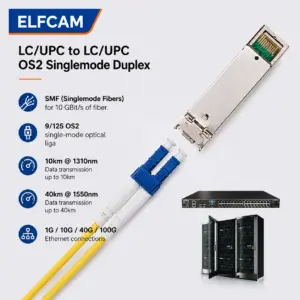
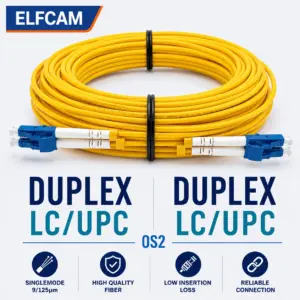
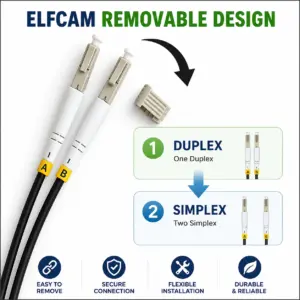
- Ref 27261 — G.657.B3 SC/APC optical fiber cable 50 m, "Pull-Eye" with pulling eyelet, 3.0 mm LSZH, indoor, compatible with Livebox/SFR Box/Bbox
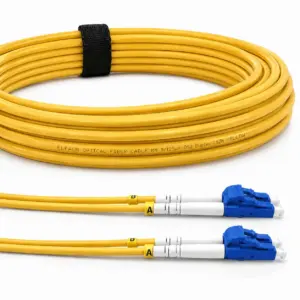
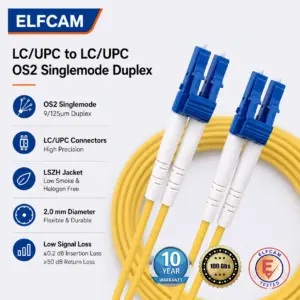
- Ref 319 — SC/APC single-mode OS2 armored patch cord, reinforced, compatible with FR operators
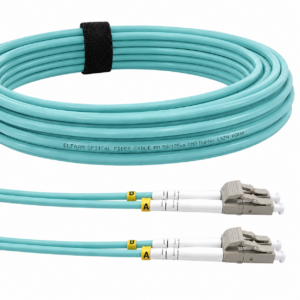
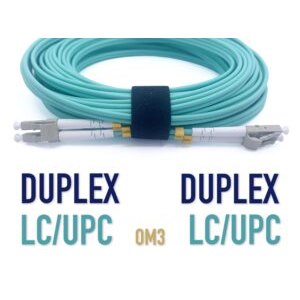
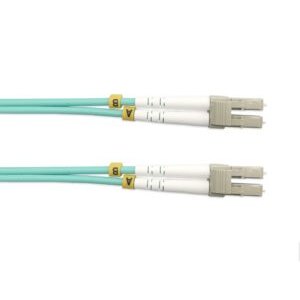
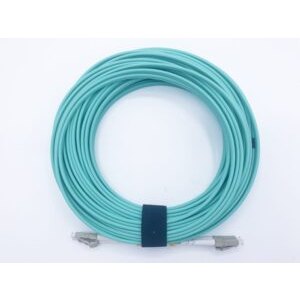
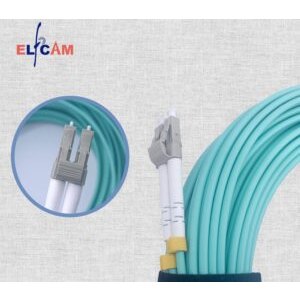
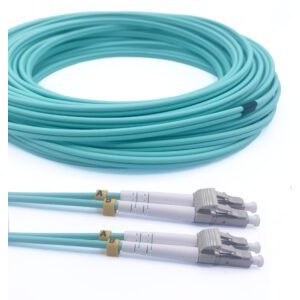
- Ref 400 — LC/UPC OM3 multimode duplex cable (for multimode datacenter comparison)
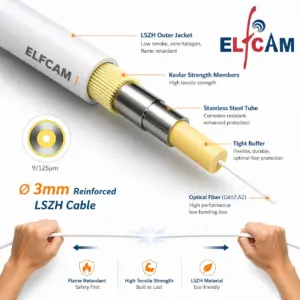
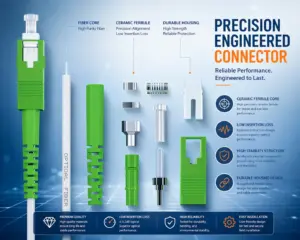
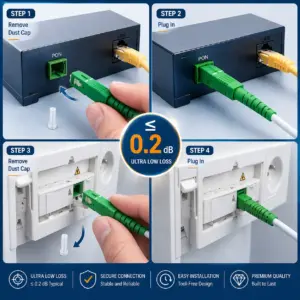
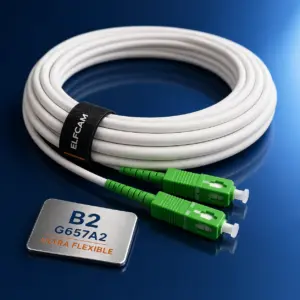

How does a bend-insensitive fiber work ?
To make a single-mode fiber insensitive to bending, manufacturers use three physical approaches, sometimes combined :
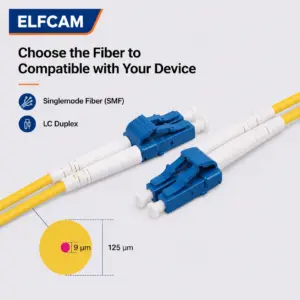
- Reduced mode field diameter (MFD) — by confining the light better in the core, the probability of it escaping during a bend is reduced. Typically MFD 8.6 µm for G.657.B3 vs 10.4 µm for G.652.
- Trench-assisted cladding — a layer of low-refractive-index glass is built into the inner cladding, forming a "trench" that pushes the light back toward the core.
- Nanostructures in the core — micro-holes or submicron inclusions that create a local photonic band-gap effect, confining the light even in a tight bend.
Key takeaway
Bend loss increases with wavelength. A fiber that holds at 1310 nm may cause problems at 1550 nm (longer infrared waves = more sensitive). Always check the G.657.xx datasheet for the wavelength of your link (GPON 1490/1550, XGS-PON 1577, etc.).
Small-diameter fibers: 80µm and 200µm
Alongside G.657, another innovation has developed : small-diameter fibers. Two approaches :
| Type | Core | Cladding | Coating | Volume gain |
|---|---|---|---|---|
| Standard | 10 µm | 125 µm | 250 µm | Reference |
| Reduced cladding | 10 µm | 80 µm | 170 µm | −54% |
| Thin coating | 10 µm | 125 µm | 200 µm | −36% |
Reduced cladding to 80 µm — divides the glass volume by 2.4. Allows you to increase fiber density in a multi-strand cable (192 fibers in a cable that previously held only 96).
Thin coating to 200 µm — a simpler solution since the cladding remains the standard 125 µm (so splices on standard machines without adaptation). Only the plastic coating is reduced.
G.652 vs G.657: full comparison
| Parameter | G.652.D (standard) | G.657.A2 | G.657.B3 |
|---|---|---|---|
| Min bend radius | 30 mm | 7.5 mm | 5 mm |
| MFD @ 1310 nm | 9.2 µm | 8.6 µm | 8.6 µm |
| Attenuation @ 1310 nm | ≤ 0.35 dB/km | ≤ 0.4 dB/km | ≤ 0.4 dB/km |
| Attenuation @ 1550 nm | ≤ 0.22 dB/km | ≤ 0.3 dB/km | ≤ 0.3 dB/km |
| G.652 compatibility | Reference | Full | Limited |
| Typical use | Long distance, backbone | FTTH access | Tight residential FTTH |
| Relative price | 1× | 1.1-1.2× | 1.2-1.4× |
FTTH and datacenter applications
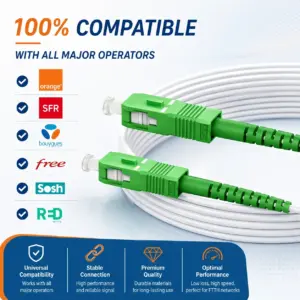
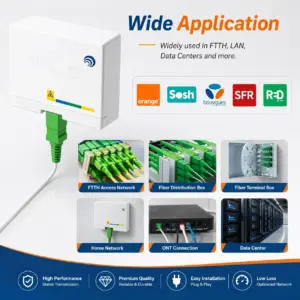
Residential FTTH — G.657.B3 has become the de facto standard for patch cords, indoor cables and PBO → PTO connections. French operators (Orange, SFR, Free, Bouygues) all require G.657.A2 minimum for residential installations.
Multi-dwelling FTTH — G.657.B3 allows an 8U riser to be run up a 25 mm conduit without needing corner pits. Savings on labor.
High-density datacenter — 1728-fiber cables in 80/170 µm fit into cable trays twice as compact as standard cables of the same density.
Reinforced outdoor installation — some G.657.B3 fibers are built into armored cables with an LSZH jacket, ideal for underground or aerial routing. See our range of armored outdoor cables.
FAQ — G.657 and small-diameter fibers
1Can a G.657 fiber be spliced with a G.652 ?
2How can you recognize a G.657.B3 fiber in the field ?
- Read the nomenclature printed on the jacket (e.g.: "ITU-T G.657.B3")
- Consult the manufacturer's datasheet
- Measure the bend loss with an OTDR by bending the fiber to 5 mm — a G.657.B3 will show < 0.05 dB/turn, a G.652 will show > 1 dB/turn.
3Is G.657 fiber compatible with GPON and XGS-PON ?
4Do you need special equipment to splice an 80 µm fiber ?
For fibers with a thin 200 µm coating (cladding stays 125 µm), no adaptation is needed.
5Can a G.657.B3 fiber be bent at 90° ?
6When should you choose G.657.A2 rather than G.657.B3 ?
G.657.B3 — if your installation constraints are extreme (radius < 7.5 mm) and the link is short (residential, building). The majority of FTTH patch cords on the market are B3.
7Does G.657 work in multimode ?
8Where to buy G.657.B3 cables in France ?
In summary
The ITU-T G.657 standard revolutionized FTTH deployment by allowing bend radii of 5-7.5 mm without signal loss. For residential and building installations : favor G.657.B3. For links with a long-distance backbone : favor G.657.A2 (G.652 compatible).
Small-diameter fibers (80/170 µm or 125/200 µm) are a plus for very high-density cables — hyperscale datacenters, building risers. See our range of optical fiber cables and G.657 pigtails.